
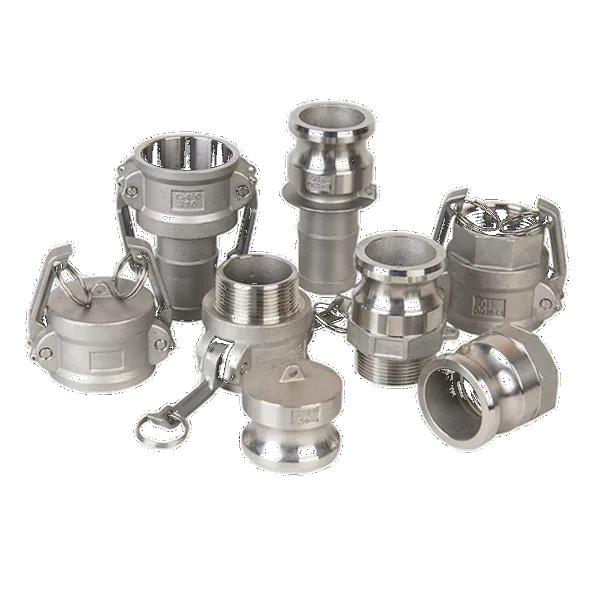


A camlock coupling, also called a cam and groove coupling, connects hoses and pipe systems without tools. The female coupler arms lock over the groove of a male adapter for fast liquid-transfer connections.
Direct answer: use Type A or F for a male adapter with thread, Type B or D for a female coupler with thread, Type C for a coupler with hose shank, Type E for an adapter with hose shank, and DC/DP to close open ends.
Camlock coupling types A-F explained
| Type | Camlock End | Opposite End | Typical Use |
|---|---|---|---|
| Type A | Male adapter | Female thread | Connect a camlock hose to male-threaded equipment. |
| Type B | Female coupler | Male thread | Connect a female camlock socket to female-threaded equipment. |
| Type C | Female coupler | Hose shank | Common hose-to-camlock connection. |
| Type D | Female coupler | Female thread | Connect to male-threaded pipe or equipment. |
| Type E | Male adapter | Hose shank | Male camlock end fitted directly to hose. |
| Type F | Male adapter | Male thread | Connect a camlock hose to female-threaded equipment. |
| Type DC | Female dust cap | Closed | Protect and close a male adapter. |
| Type DP | Male dust plug | Closed | Protect and close a female coupler. |
How to choose camlock size
The nominal size describes the mating cam and groove connection. It is not always the same as outside diameter, hose-shank OD or thread OD.
- Identify the mating adapter or coupler and nominal size.
- Measure hose inside diameter for Type C or E hose shanks.
- Confirm NPT, BSP or other thread standard for threaded types.
- Check flow rate, working pressure, temperature and fluid compatibility.
- Confirm whether reducing, jump-size or flange-ended fittings are needed.
Material selection: stainless steel, aluminum, PP or nylon
| Material | Why Buyers Choose It | Typical Applications |
|---|---|---|
| SS316 / SS304 | Corrosion resistance, strength and cleanability. | Chemical, food, marine and demanding industrial transfer. |
| Aluminum | Light weight, good value and easy hose handling. | Water, fuel, agriculture and general liquid transfer where compatible. |
| Polypropylene | Economical chemical resistance and low weight. | Agriculture, water treatment and selected chemical service. |
| Nylon | Light weight, impact resistance and non-metallic construction. | Water, agricultural and selected industrial transfer. |
| Brass | Durability in selected water and petroleum services. | Marine, fuel and general industrial applications where specified. |
Gasket material is part of coupling selection
EPDM is commonly reviewed for water and weathering, NBR for oil service, FKM for stronger chemical and heat resistance, and PTFE envelope designs for selected aggressive fluids. Confirm swelling, compression set and temperature before ordering.
Common ordering mistakes
- Mixing NPT and BSP threads.
- Measuring only outside diameter instead of nominal camlock size.
- Choosing body material without checking the gasket.
- Using standard camlocks for compressed air or gas without an approved system.
- Ignoring pressure reduction at larger sizes or higher temperatures.
- Ordering Type C and Type E backwards.
Camlock RFQ checklist
- Type A, B, C, D, E, F, DC or DP.
- Nominal coupling size and hose ID.
- Thread type and direction.
- Body, handle and gasket material.
- Fluid, temperature and working pressure.
- Standard, certificates, quantity and packaging.
FAQ
What are the standard camlock types?
The common configurations are Type A-F, plus DC dust caps and DP dust plugs.
How do I measure camlock size?
Confirm nominal mating size, then separately verify hose ID or thread standard. Do not order from outside diameter alone.
Can camlocks carry compressed air?
Standard cam and groove couplings should not be assumed safe for compressed air or gas.
Which material should I choose?
Base the choice on fluid, corrosion, temperature, pressure, weight and cost.